
If you've ever Googled "fasting blood sugar normal range by age", you're not alone — it's one of the most searched health queries because blood test reports offer numbers without context.
Here's the truth most guides skip: a fasting blood sugar of 92 mg/dL means something different at 24 than it does at 52. Not because the medical thresholds change — they don't. But metabolism, risk, and lifestyle context change significantly across decades.
This blog breaks down normal blood sugar levels by age group — your 20s, 30s, 40s, and 50s — with real numbers, age-specific risks, and what you should actually do based on where your result lands.
1.Why Fasting Blood Sugar Changes With Age
Your body regulates blood sugar through two mechanisms working in sync:
- Insulin production — your pancreas releasing insulin in response to glucose
- Insulin sensitivity — your cells responding to insulin and absorbing glucose efficiently
Both change with age. Insulin sensitivity naturally declines after your 30s — meaning cells gradually become less responsive. The pancreas compensates by producing more insulin, but over decades — especially with inactivity, weight gain, or poor diet — this compensation starts to fail.
The result is a slow, steady rise in fasting blood sugar by age that most people don't notice until a blood test flags it.
What the Research Shows
A large-scale analysis in Diabetes Care (2010), tracking over 46,000 individuals, found that average fasting plasma glucose increases by approximately 0.4–0.5 mg/dL per year after age 30 in non-diabetic adults. That's roughly 10 mg/dL over two decades — enough to move someone from comfortably normal to the prediabetes threshold without any dramatic lifestyle changes.

2. Standard Fasting Blood Sugar Reference Ranges
Before looking at fasting glucose by age, understand the universal clinical benchmarks that apply to all adults:
Fasting Blood Sugar Normal Range — All Adults
| Fasting Blood Sugar | Classification |
| Below 70 mg/dL | Low — Hypoglycemia |
| 70 – 99 mg/dL | Normal |
| 100 – 125 mg/dL | Prediabetes (Impaired Fasting Glucose) |
| 126 mg/dL and above | Diabetes (requires confirmatory test) |
Unit conversion (mmol/L):
Normal = 3.9–5.5 |
Prediabetes = 5.6–6.9 |
Diabetes = 7.0+ Multiply mmol/L × 18 to convert to mg/dL.
What does change by age is the typical distribution of readings, the risk factors in play, and the most likely cause of an elevated number.
3.Fasting Blood Sugar Normal Range by Age Group
In Your 20s (20–29)
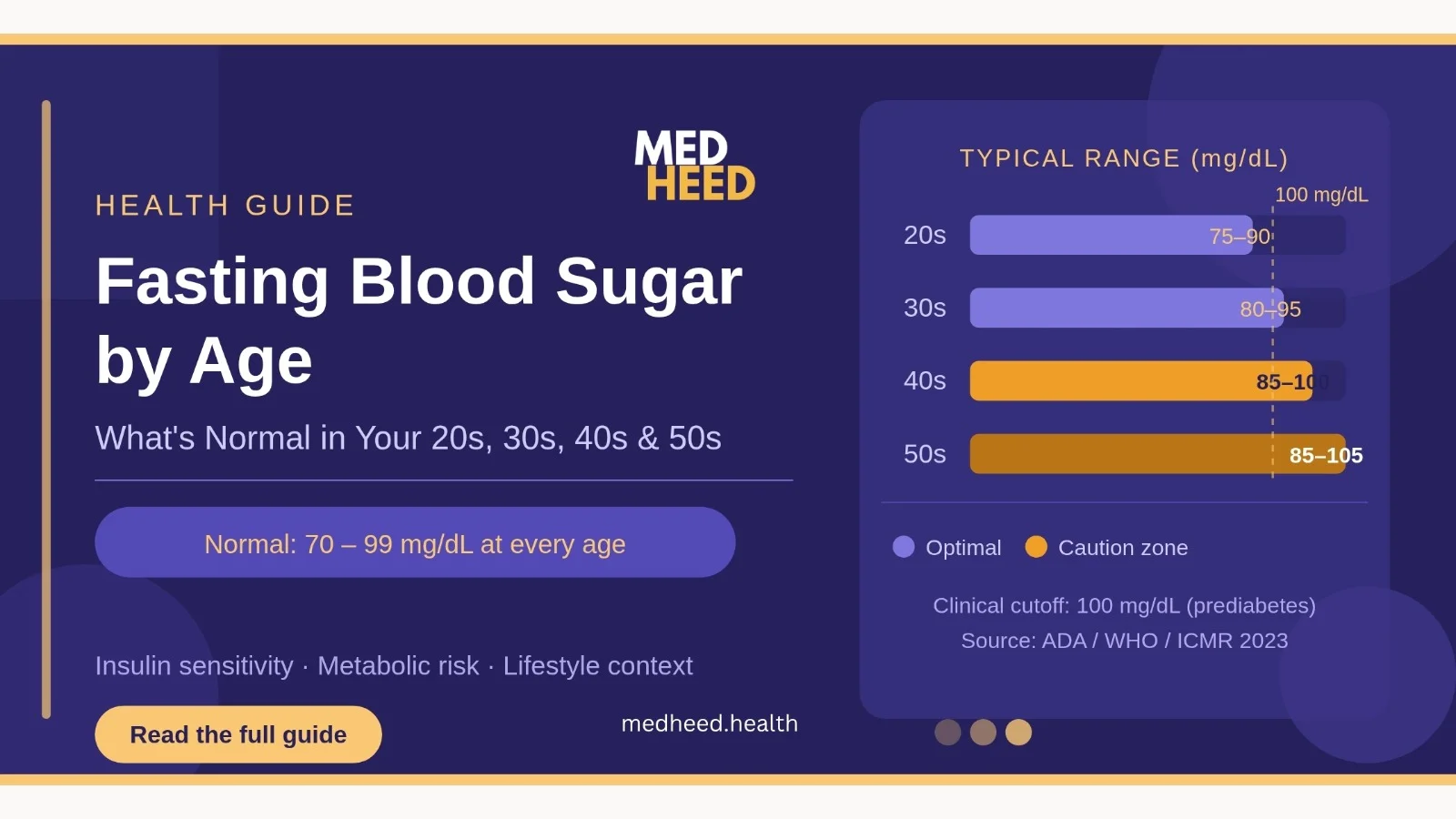
Normal range: 75–90 mg/dL
Your insulin sensitivity is strongest here. High fasting sugar in your 20s is uncommon and often linked to PCOS, stress, poor sleep, or unhealthy eating habits.
Watch for: Anything above 95 mg/dL.
In Your 30s (30–39)
Normal range: 80–95 mg/dL
Stress, weight gain, less movement, and post-pregnancy changes can slowly raise blood sugar during this decade.
Watch for: 95–99 mg/dL is an early warning sign.
In Your 40s (40–49)
Normal range: 85–100 mg/dL
Your 40s are the biggest turning point for prediabetes risk as muscle mass and insulin sensitivity naturally decline.
Watch for: 100 mg/dL or higher may indicate prediabetes.
In Your 50s (50–59)
Normal range: 85–105 mg/dL
Hormonal changes, muscle loss, medications, and years of metabolic stress can all impact fasting sugar levels.
Watch for: Regular monitoring becomes essential in this decade
Fasting Blood Sugar by Age — Summary Chart
| Age Group | Typical Range | Optimal Target | Key Risk Factor |
| 20s | 75–90 mg/dL | Below 90 mg/dL | PCOS, inactivity, undiagnosed T2D |
| 30s | 80–95 mg/dL | Below 95 mg/dL | Abdominal weight gain, post-pregnancy |
| 40s | 85–100 mg/dL | Below 99 mg/dL | Prediabetes onset, hormonal shifts |
| 50s | 85–105 mg/dL | Below 100 mg/dL | Menopause, muscle loss, medications |
Important: Typical ranges reflect population averages — not goals. The clinical target for all ages remains below 100 mg/dL. Typical is not optimal.
4. What to Do at Each Age to Maintain Normal Blood Sugar Levels
Habit Section: Age-Specific Priorities
In Your 20s — Build the Foundation
Your insulin sensitivity is strongest now. Stay active, limit ultra-processed foods, sleep well, and test yearly if you have PCOS.
In Your 30s — Protect What You Have
Manage stress, reduce belly fat, stay consistent with movement, and monitor yearly if you had gestational diabetes.
In Your 40s — Intervene Early
Fasting sugar of 100–115 mg/dL needs action. Add strength training, cut refined carbs, and assess diabetes risk regularly.
In Your 50s — Stay Consistent
Lifestyle changes still work. Focus on resistance training, lower refined carbs, and monitor fasting glucose and HbA1c regularly.
Same Number, Different Ages, Different Meaning
Zara, 26, Pune Fasting glucose: 97 mg/dL — technically normal. But Zara has PCOS, a desk job, and minimal activity. Her doctor ordered an OGTT (oral glucose tolerance test), which showed impaired glucose tolerance despite the normal fasting result. After six months of daily 30-minute walks and reduced refined carbs: fasting glucose dropped to 86 mg/dL, OGTT normalised.
Rajesh, 44, Mumbai Fasting glucose: 104 mg/dL. His doctor suggested rechecking in a year. Rajesh asked for an HbA1c — it came back at 5.9%, confirming prediabetes. He joined a structured walking programme and reduced evening rice. Nine months later: fasting glucose 92 mg/dL, HbA1c 5.5%.
Sunita, 53, Delhi Fasting glucose: 112 mg/dL — rose after menopause from a stable baseline of 88. Given her family history, her doctor prioritised diet and exercise before considering medication. Twelve months later: fasting glucose 98 mg/dL.
5.Track Your Blood Sugar Trend Across the Decades
A single test gives you a snapshot. Your fasting blood sugar normal range by age only makes sense when seen as a trend over time.
Tracking Section — What to Monitor and When
| Marker | Why It Matters | How Often |
| Fasting blood sugar | Core metabolic marker across decades | Annually; every 3–6 months if borderline |
| HbA1c | 3-month average — full picture | Annually from 35; every 6 months if prediabetic |
| Waist circumference | Visceral fat is the top driver of insulin resistance | Every 1–2 months |
| Body weight trend | Contextualises glucose changes | Monthly |
| Fasting insulin (optional) | Detects insulin resistance before glucose rises | Every 1–2 years if at risk |
Medheed lets you upload blood reports and visualise these markers as a trend — so you can see whether your fasting glucose is drifting upward across years, or whether your lifestyle changes are reversing it. Across decades, that longitudinal view is invaluable — it tells you and your doctor things that no single reading can.
When to See a Doctor
- Any age: Fasting glucose at or above 100 mg/dL — confirm with a repeat test and HbA1c
- 20s–30s: Reading above 95 mg/dL with risk factors (PCOS, family history, obesity, inactivity)
- 40s–50s: Annual testing regardless of prior normal results
- Post-pregnancy: Test fasting glucose annually after gestational diabetes
- Any age: Fasting glucose trending upward year-on-year, even within normal range
The ADA recommends screening from age 35 for all adults, and earlier for anyone with overweight, family history, or other metabolic risk factors.
FAQ
Q: Is 98 mg/dL a normal blood sugar at 50? Clinically yes — it is within the normal range. But if it represents an upward trend from earlier readings in the low 80s, particularly with abdominal weight gain or a family history of diabetes, it warrants attention and a follow-up HbA1c.
Q: Can a 25-year-old have prediabetes? Absolutely. The CDC estimates 96 million Americans have prediabetes — and young adults in their 20s and 30s are increasingly represented. Age does not protect against insulin resistance.
Q: How much does sleep affect fasting blood sugar by age? Significantly at all ages — but increasingly so with age. Even one night of under-5-hour sleep can raise next-morning fasting glucose by 10–15 mg/dL in people with borderline readings. Chronic sleep deprivation is a consistently underappreciated driver of rising blood sugar across every decade.
Q: Does normal blood sugar range change after 50? Clinically no — the ADA threshold stays the same. But metabolic changes after 50 (menopause, muscle loss, medication effects) mean that maintaining normal blood sugar levels requires more deliberate effort. Annual testing and HbA1c monitoring are particularly important in this decade.
Conclusion
Understanding your fasting blood sugar normal range by age is one of the most practical things you can do for long-term health. The number on your report doesn't exist in isolation — it exists within the context of your decade, your risk profile, and your trajectory.
Key takeaways:
- Normal blood sugar levels by age follow the same clinical thresholds — 70–99 mg/dL is healthy at every age
- But typical readings drift upward decade by decade — common is not optimal
- Blood sugar levels in your 20s and 30s respond best and fastest to lifestyle changes
- Fasting glucose in your 40s and 50s requires more active, consistent management
- The trend across multiple tests tells a more important story than any single reading
- Use Medheed to track that trend and turn scattered lab reports into a clear, actionable picture
Whatever decade you're in, the best time to start paying attention to your fasting blood sugar by age was ten years ago. The second best time is today.
References
- American Diabetes Association. (2023). Standards of Medical Care in Diabetes — Classification and Diagnosis. Diabetes Care, 46(Suppl 1).
- Cowie, C.C. et al. (2010). Full Accounting of Diabetes and Pre-Diabetes in the U.S. Population. Diabetes Care, 33(2), 287–289.
- Tabák, A.G. et al. (2012). Prediabetes: A high-risk state for developing diabetes. The Lancet, 379(9833), 2279–2290.
- Knowler, W.C. et al. (2002). Reduction in incidence of Type 2 diabetes with lifestyle intervention (DPP Trial). New England Journal of Medicine, 346, 393–403.
- Spiegel, K. et al. (2009). Sleep loss: A novel risk factor for insulin resistance and Type 2 diabetes. Journal of Applied Physiology, 99(5), 2008–2019.