
Three Tests. One Confusion. Let's Fix That.
Divya, 29, went to her doctor exhausted, pale, and losing hair. Her doctor ordered an iron panel. The report came back with three different numbers- serum iron, ferritin, TIBC all flagged differently. Her serum iron looked low. Her ferritin was borderline. Her TIBC was high. She had no idea what any of it meant or which number actually mattered.
If you've ever stared at an iron panel feeling more confused than when you started this blog is for you.
Serum Iron, Ferritin & TIBC — What Is Each Test Actually Measuring?
They all relate to iron, but each one is measuring something completely different.
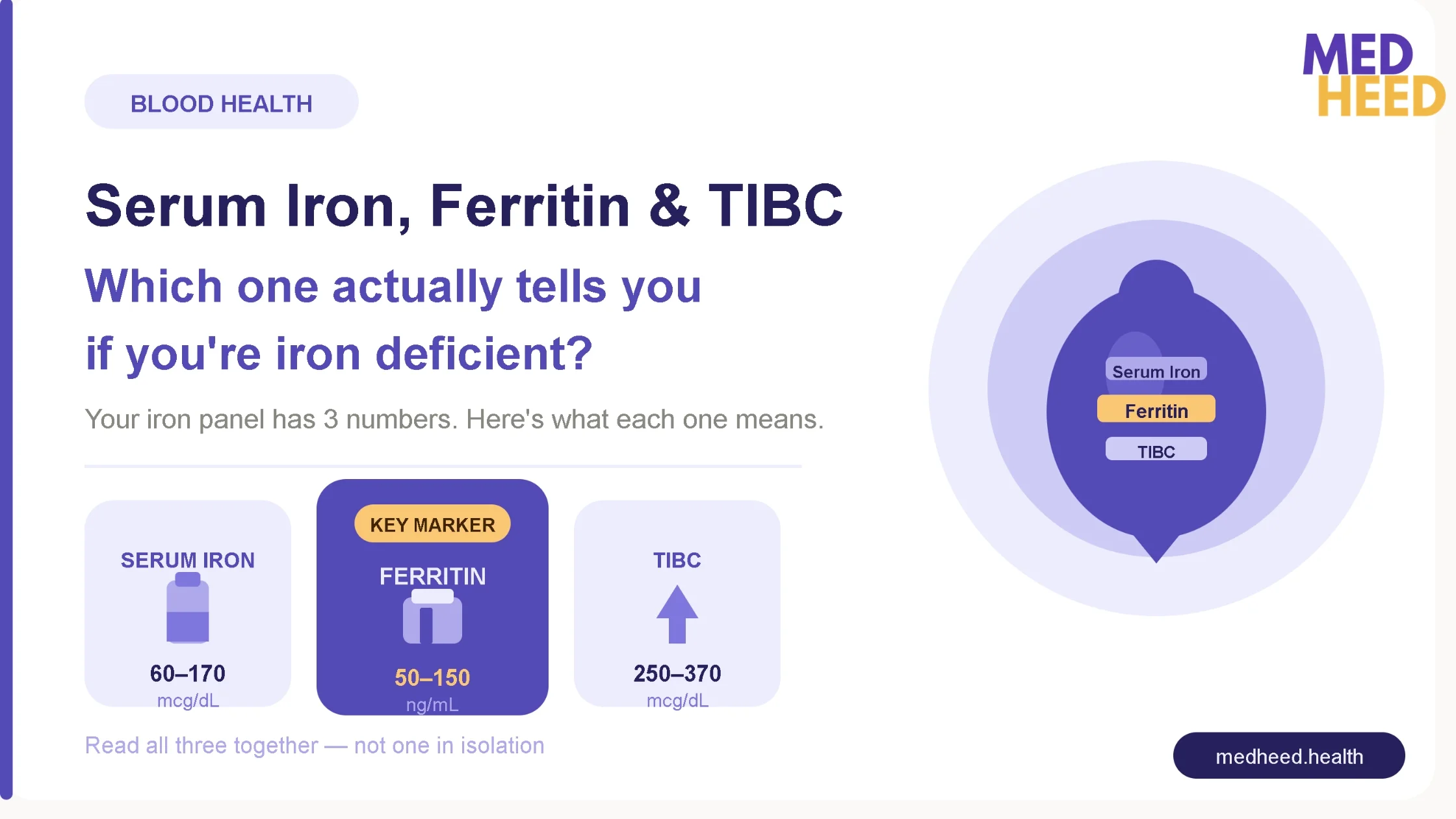
A. Serum Iron measures how much iron is currently floating in your blood at the moment of the test. Think of it as a live snapshot — what's in circulation right now. Normal range: 60–170 mcg/dL.
B. Ferritin measures your iron stores — how much iron your body has saved up in reserve. This is the most important number for catching iron deficiency early, before it becomes anemia. Normal range: 12–150 ng/mL for women, 12–300 ng/mL for men. Optimal for most adults: 50–150 ng/mL.
C.TIBC (Total Iron Binding Capacity) measures how much capacity your blood has to carry iron - essentially how "hungry" your blood is for more iron. When iron is low, TIBC goes up because the body creates more carrier proteins desperate to grab whatever iron it can find. Normal range: 250–370 mcg/dL.
Why Can't You Just Check One Number?
Because each test alone tells an incomplete story.
Serum iron fluctuates wildly throughout the day. It can drop after a bad night's sleep, rise after a red meat meal, and shift based on stress or inflammation. Checking only serum iron is like checking the weather at one moment and assuming that's what it's like all year.
Ferritin is more stable and more telling — but it has one major blind spot. Ferritin is also an inflammatory marker. If you have an infection, autoimmune condition, or chronic inflammation, ferritin can appear falsely normal or high even when your iron stores are actually depleted.
TIBC alone doesn't tell you if you're deficient — it tells you if your body is behaving like it's deficient. High TIBC + low ferritin + low serum iron together? That's a clear picture.
The three tests only make sense when read together.
How to Read Your Iron Panel — The Pattern That Matters
| Pattern | Serum Iron | Ferritin | TIBC | What It Matters |
| Iron deficiency | Low | Low | High | Classic deficiency stores depleted |
| Early deficiency | Normal | Low | Normal/High | Stores dropping, symptoms starting |
| Anaemia of chronic disease | Low | Normal/High | Low/Normal | Iron locked up, not truly deficient |
| Optimal iron status | Normal | 50/100 | Normal | Healthy |
| Iron overload | High | High | Low | Too much iron needs investigation |
The most dangerous pattern to miss is early deficiency — where serum iron still looks normal but ferritin is already falling. This is exactly what gets missed when doctors only check a standard blood count without ordering ferritin separately.
Real Talk: The Test That Gets Missed Most Often
Arjun, 35, a software engineer, had been fatigued and foggy for eight months. His complete blood count was normal. His hemoglobin was 13.8 g/dL — perfectly fine for a man. Nobody ordered ferritin.
When he finally pushed for a full iron panel, his ferritin came back at 9 ng/mL. Critically low. His serum iron was 58 mcg/dL — just barely below range but easy to overlook. His TIBC was 390 mcg/dL — elevated, showing his body was actively searching for more iron.
Three months of prescribed supplementation later, his ferritin hit 54 ng/mL. The fatigue lifted. The brain fog cleared.
The test that cracked it? Ferritin. The one that almost wasn't ordered.
Which Test Should You Ask For?
If you're experiencing fatigue, hair loss, brain fog, or low mood — and your routine blood test came back normal — ask your doctor specifically for:
- Serum ferritin — the most sensitive early marker of iron deficiency
- Serum iron — to see what's currently in circulation
- TIBC — to understand how iron-hungry your body currently is
- Transferrin saturation — a bonus marker, calculated from serum iron and TIBC; below 20% suggests deficiency, above 50% suggests overload
These four together give a complete iron picture. A standard CBC or hemoglobin test alone will miss early iron deficiency almost every time.
FAQs
Q: Can I be iron deficient with a normal hemoglobin?
Yes — and this is the most common missed diagnosis. Hemoglobin only drops in the later stages of iron deficiency. Ferritin depletes first, often months before hemoglobin is affected.
Q: My serum iron is low but ferritin is normal. Am I deficient?
Not necessarily. Low serum iron with normal ferritin could reflect daily fluctuation, recent diet, or early-stage changes. Watch the pattern across all markers, not just one.
Q: Why is my TIBC high?
High TIBC usually means your body is low on iron and is producing more carrier proteins to capture what little is available. Combined with low ferritin, this strongly points to iron deficiency.
Q: Is ferritin always accurate?
Not always. In people with inflammation, infection, liver disease, or autoimmune conditions, ferritin can read falsely elevated — masking true deficiency. In these cases, C-reactive protein (CRP) is checked alongside ferritin to see if inflammation is distorting the result.
How Medheed Can Help
An iron panel with three or four flagged numbers is genuinely confusing — even for people who understand health reports. Medheed breaks down your serum iron, ferritin, and TIBC results in plain language, shows you how they relate to each other, and tells you what the pattern means for your health — so you walk into your doctor's appointment knowing exactly what to ask.
The Bottom Line
No single iron test tells the full story. Serum iron is too unstable. TIBC alone is too indirect. Ferritin is the most important marker — but even it needs context from the rest of the panel.
If you've been feeling off and your standard tests look fine, ask for a full iron panel. The number that explains everything might be the one nobody checked yet.
References
- Camaschella, C. (2015). Iron-deficiency anemia. New England Journal of Medicine, 372(19), 1832–1843. https://doi.org/10.1056/NEJMra1401038
- Ganz, T. (2013). Systemic iron homeostasis. Physiological Reviews, 93(4), 1721–1741.
- Killip, S., et al. (2007). Iron deficiency anemia. American Family Physician, 75(5), 671–678.
- Thomas, C., & Thomas, L. (2002). Biochemical markers and hematologic indices in the diagnosis of functional iron deficiency. Clinical Chemistry, 48(7), 1066–1076.
- World Health Organization. (2020). Nutritional Anaemias: Tools for Effective Prevention and Control. https://www.who.int
- Indian Council of Medical Research (ICMR). Micronutrient deficiency guidelines. https://www.icmr.nic.in