
Your Hemoglobin is Fine. So Why Do You Feel So Tired?
You got your blood test done. Hemoglobin looks normal. Your doctor says everything is fine. But you're still exhausted by the afternoon. Your hair is falling more than usual. You can't focus at work. You feel breathless doing things that never bothered you before.
Sound familiar?
Here's something most people don't know: you can have iron deficiency even when your hemoglobin is perfectly normal.
The number that tells that story is called ferritin — and it's one of the most overlooked values in a standard blood report. If your report shows low ferritin but normal hemoglobin, your body may already be running low on iron reserves — quietly, without any obvious alarm.
What is Ferritin — And Why Does It Matter?
What is Ferritin — And Why Does It Matter? Most people have heard of hemoglobin. Ferritin? Not so much.
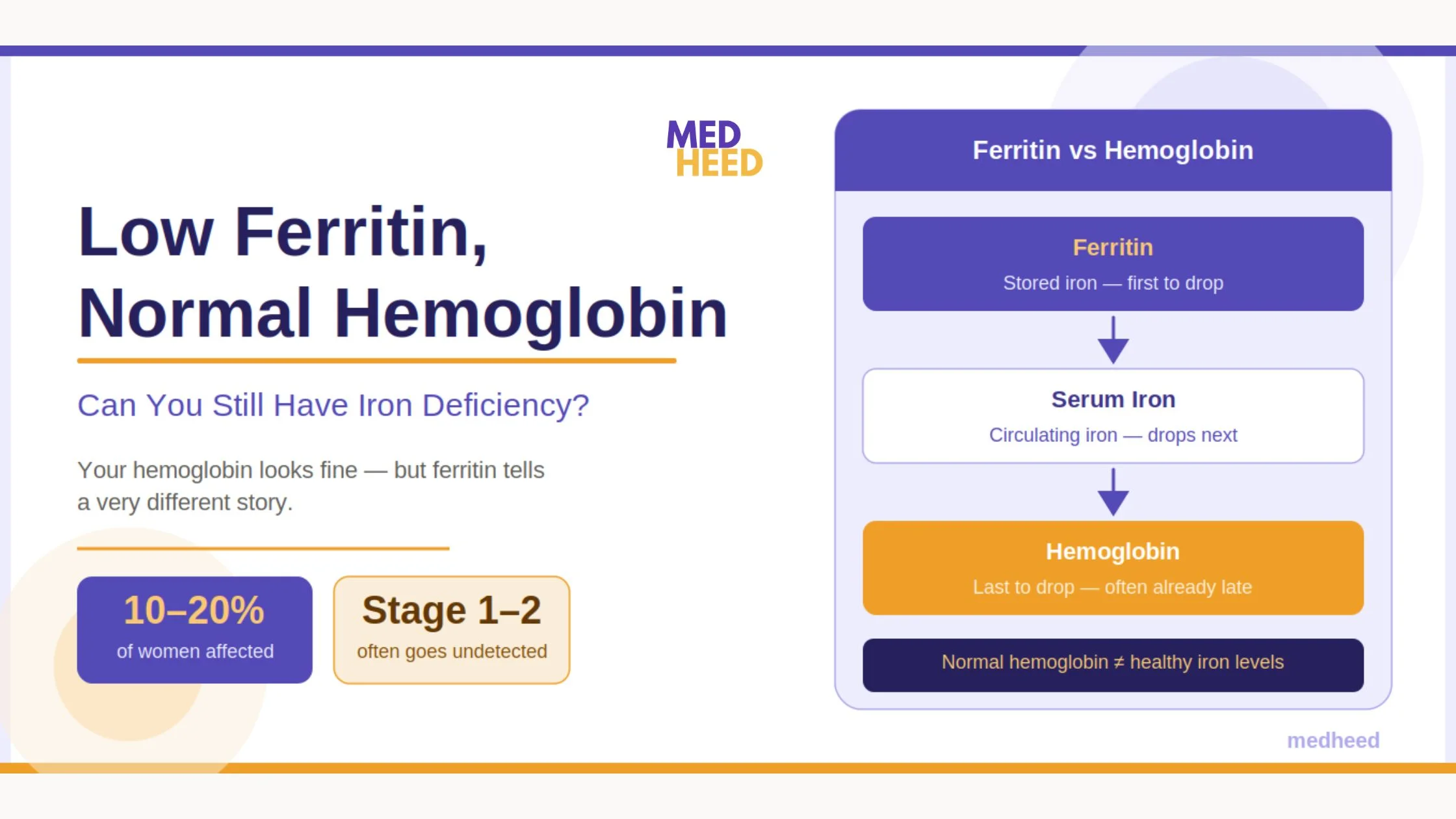
Ferritin is a protein that stores iron in your body — think of it as your iron savings account. When your daily intake falls short, your body quietly withdraws from this account to keep things running.
The catch? It happens silently. Hemoglobin stays normal, red blood cells look healthy — but iron stores are shrinking.
This is called iron deficiency without anemia, and it's more common than most people realise. A simple way to think about it: Hemoglobin = iron in use right now Ferritin = iron saved for later By the time hemoglobin drops, the deficiency has already been going on for a while.
Low Ferritin Normal Hemoglobin — What Does It Actually Mean?
If your blood test shows low ferritin with normal hemoglobin, it means:
- Your body is using its stored iron faster than it's replacing it
- You haven't developed full anemia yet — but you're heading toward iron depletion
- Symptoms can already be present even before hemoglobin drops
This stage is called Stage 1 or Stage 2 iron deficiency — where iron stores are depleted but red blood cell production hasn't been affected yet.
Many people stay in this zone for months or even years without knowing it, because standard reports don't always flag low ferritin as a concern if hemoglobin looks fine.
Symptoms of Low Ferritin You Shouldn't Ignore
This is where it gets important. Low ferritin symptoms are real — even without anemia.
If you've been experiencing any of these, your ferritin level deserves a closer look:
- Constant fatigue — tired even after a full night's sleep
- Hair thinning or excess hair fall — one of the most common early signs
- Difficulty concentrating — brain fog, forgetting things, low mental energy
- Shortness of breath on mild exertion
- Restless legs — uncomfortable urge to move legs, especially at night
- Feeling cold more often than others
- Low mood or irritability without an obvious reason
- Brittle nails or nails that break easily
- Frequent headaches
Ferritin Levels — What the Numbers Mean
Understanding your ferritin report is simpler than it looks.
| Ferritin Level | Range | What It May Indicate |
| Optimal | 30–200 ng/mL (women) / 30–300 ng/mL (men) | Healthy iron stores |
| Low Normal | 12–29 ng/mL | Borderline — worth monitoring |
| Deficient | Below 12 ng/mL | Iron stores are depleted |
| Critically Low | Below 6 ng/mL | Significant depletion — needs attention |
| High | Above 300–500 ng/mL | May indicate inflammation or other conditions |
Why Does Ferritin Drop Even When Hemoglobin Stays Normal?
Common reasons ferritin drops include:
- Low iron intake — not eating enough iron-rich foods regularly
- Poor iron absorption — even with good diet, some bodies absorb iron poorly
- Heavy periods (menstruation) — one of the leading causes in women
- Frequent blood donation
- Pregnancy — iron demands increase significantly
- Gut conditions — such as IBS, celiac disease, or low stomach acid
- High-intensity exercise — athletes often have lower ferritin levels
- Chronic low-grade inflammation — which can interfere with iron storage
The Difference Between Ferritin, Hemoglobin, and Serum Iron
These three are related — but they measure very different things. Knowing the difference helps you read your report more clearly.
| Marker | What It Measures | When It Drops |
| Ferritin | Stored iron in your body | Early stage — first to decline |
| Serum Iron | Iron currently circulating in blood | Mid stage — drops after ferritin |
| Hemoglobin | Iron being used in red blood cells | Late stage — drops last |
| TIBC | Capacity to carry iron in blood | Rises when iron stores are low |
Checking only hemoglobin is like checking your fuel gauge only when your car stops. Ferritin gives you the warning much earlier.
What Your Report May Actually Be Telling You
| Situation | What It May Mean | What to Do Next |
| Low ferritin + Normal hemoglobin | Early iron depletion — stores running low | Recheck with full iron panel; review diet and absorption |
| Low ferritin + Low hemoglobin | Iron deficiency anemia — confirmed | Consult a doctor; iron supplementation likely needed |
| Normal ferritin + Low hemoglobin | Anemia from another cause (not iron) | Investigate B12, folate, or other causes |
| High ferritin + Low hemoglobin | Possible inflammation masking iron deficiency | Needs further investigation |
| Low ferritin + Symptoms present | Iron deficiency without anemia — needs attention | Don't wait for hemoglobin to drop; act early |
Simple Habits That Quietly Drain Your Ferritin
Things that may be working against you:
- Drinking tea or coffee with meals — tannins block iron absorption
- Low protein diet — reduces heme iron intake
- Eating calcium-rich foods with iron-rich foods — calcium competes with iron absorption
- Skipping meat without replacing with iron-rich plant foods
- Antacid overuse — low stomach acid reduces iron absorption significantly
- Ignoring heavy periods — even "slightly heavier" cycles over months add up
- High-stress lifestyle — chronic stress increases iron demand
- Excess dairy intake — especially in young women
These habits may not seem significant in isolation but over months, they can silently drain your ferritin without you realising.
How to Increase Ferritin Levels Naturally.
Food sources that help raise ferritin:
- Red meat, chicken, and fish (heme iron — best absorbed)
- Spinach, lentils, chickpeas, kidney beans
- Pumpkin seeds and sesame seeds
- Fortified cereals
- Tofu and tempeh
- Dark chocolate (yes, really)
How Medheed Helps You Track Iron Health
Instead of staring at confusing numbers on your blood report:
With Medheed, you can:
- Upload your blood test reports
- Track ferritin and hemoglobin trends over time
- Understand what your iron levels mean in simple language
- Get notified when values move in the wrong direction
- Monitor multiple biomarkers in one place
Because understanding your iron health shouldn't require a medical degree.
Frequently Asked Questions
Can low ferritin cause hair loss even with normal hemoglobin? Yes. Hair follicles are sensitive to iron stores. Ferritin below 30 ng/mL is commonly linked to increased hair shedding — even when hemoglobin is completely normal.
What is a good ferritin level? Most functional medicine practitioners recommend ferritin above 30 ng/mL for symptom-free health. For women with hair loss, levels above 50–70 ng/mL may be needed for noticeable improvement.
Can I take iron supplements without a doctor's advice? It's best not to. Too much iron is harmful. Always confirm your ferritin level before supplementing.
How long does it take to raise ferritin levels? With consistent dietary changes, ferritin typically improves in 3–6 months. With supplements under medical supervision, improvement can be seen in 6–8 weeks.
Is low ferritin the same as anemia? No. Low ferritin means your iron stores are low. Anemia means your red blood cells are affected. You can have low ferritin without anemia — and that's exactly what this blog is about.
Conclusion
Your hemoglobin being normal doesn't automatically mean your iron levels are fine.
Low ferritin with normal hemoglobin is a real condition — and it can cause genuine, frustrating symptoms that affect your daily life. Ferritin is the early warning system. Hemoglobin is the last line of defence.
The earlier you check, understand, and track your ferritin levels, the better your chances of catching iron depletion before it becomes a bigger problem. Don't wait for your hemoglobin to drop. By then, your body has already been quietly struggling for a while.
Start reading your full report — not just the numbers that are flagged.
References
- Soppi, E.T. (2018). Iron deficiency without anemia — a clinical challenge. Clinical Case Reports, Wiley Online Library. https://onlinelibrary.wiley.com/doi/full/10.1002/ccr3.1529
- Pasricha, S.R., et al. (2021). Iron deficiency. The Lancet, 397, 233–248. https://www.thelancet.com/journals/lancet/article/PIIS0140-6736(20)32594-0/fulltext
- Mei, Z., et al. (2021). Physiologically based serum ferritin thresholds for iron deficiency in non-pregnant women. The Lancet Haematology, 8(8), e572–e582. https://www.thelancet.com/journals/lanhae/article/PIIS2352-3026(21)00168-X/abstract
- NIH/PubMed Central (2024). Iron deficiency in non-pregnant women with normal hemoglobin. https://www.ncbi.nlm.nih.gov/pmc/articles/PMC12908407/
- World Health Organization. WHO Guideline on Use of Ferritin Concentrations to Assess Iron Status. https://www.who.int/publications/i/item/9789240012233