
You just received your blood test report and your LDL reads 130 mg/dL — or maybe 160. Is that a
number to worry about? Should you call your doctor right now, or is it something you can manage
with a few dietary tweaks? This blog answers those questions clearly, explains what your lipid
panel report actually means, and shows you how the Medheed app can help you track and
understand every number.
What Is LDL Cholesterol, Really?
LDL (Low-Density Lipoprotein) is often called “bad cholesterol”—but that’s only part of the story.
Think of LDL as a transport system. It carries cholesterol through your blood to support:
- Cell structure
- Hormone production
- Brain function
The issue isn’t LDL itself—it’s too much LDL over time. Excess LDL can deposit in artery walls, forming plaque. Over years, this may lead to:
- Heart attack or stroke
- Narrowed arteries
- Reduced blood flow

The LDL Numbers Explained — What Each Range Actually Means
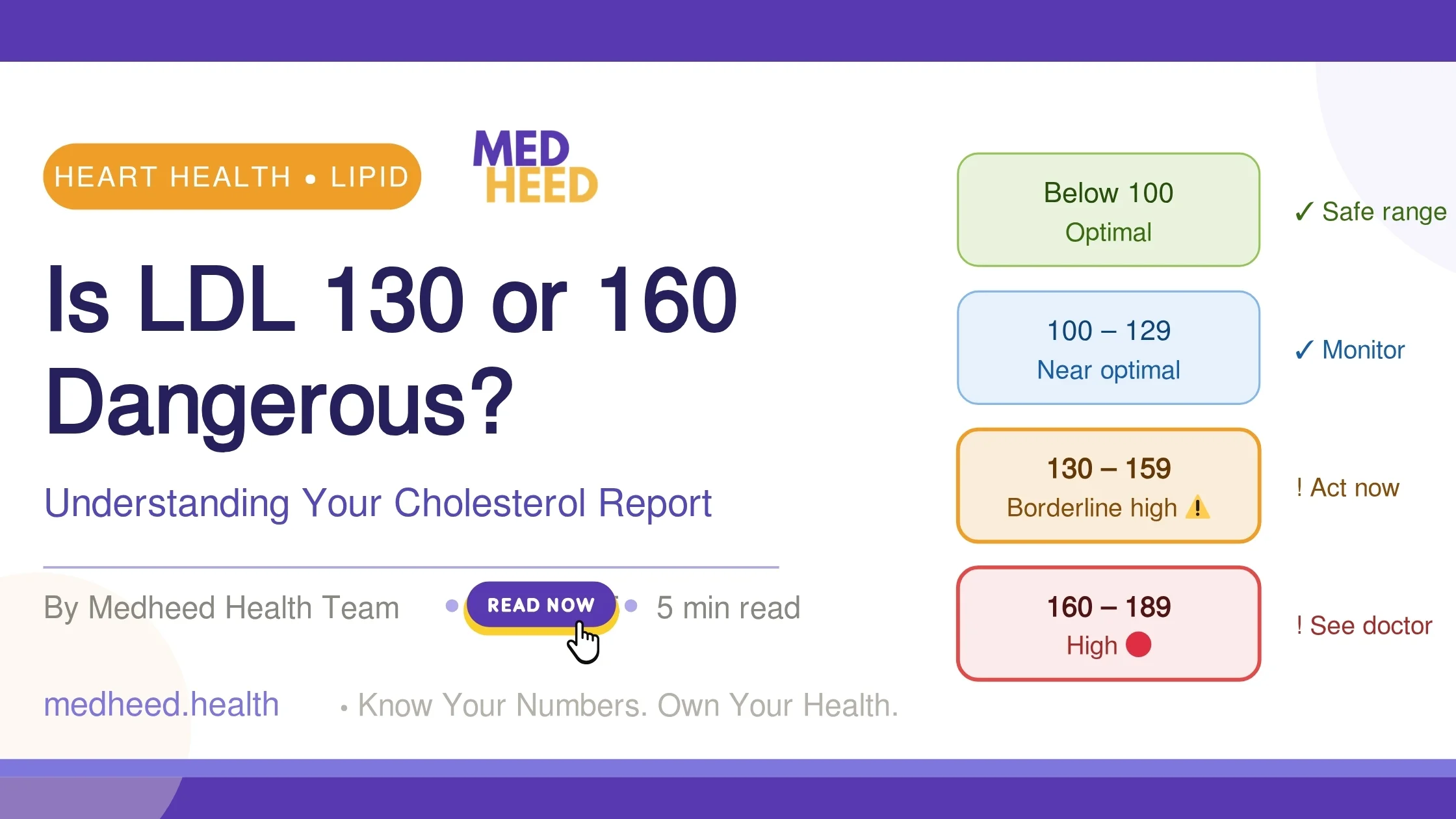
| LDL Levels (mg/dl) | Category | What it Means | Action Needed |
| <70 | Optimal | Ideal for very high-risk patients | Maintain Lifestyle |
| 70-99 | Near Optimal | Good range for most adults | Regular monitoring |
| 100-129 | Borderline Low | Acceptable for low risk individual | Healthy diet and exercise |
| 130-159 | Borderline High | Mid risk- needs attention | Lifestyle changes |
| 160-189 | High | Significant Cardiovascular risk | Doctor consultation |
| >190 | Very High | Serious risk of heart disease | Immediate medical core |
LDL 130 vs 160: The Real Risk Difference
- LDL 130 → Moderate concern
Risk depends on your overall health profile - LDL 160 → Clear increased lifetime heart risk
This is not just “slightly higher”—it’s a clinically significant jump
Research shows:
LDL ≥160 mg/dL is linked to ~70–90% higher risk of cardiovascular death over time
Is LDL 130 Dangerous?
Honestly — it depends on you, not just the number.
At 130, you're in the borderline high zone. For a young, otherwise healthy person with no other risk factors, this is a wake-up call, not an emergency.

What About LDL 160?
At 160, the conversation changes. This is classified as High by every major medical guideline, and most doctors won't just monitor it — they'll act. The 2018 AHA/ACC guidelines recommend calculating your 10-year cardiovascular risk score at this level. If that score is 7.5% or higher, medication (typically statins) is discussed alongside lifestyle changes.
Why Context Matters More Than the Number
LDL alone doesn’t define your risk. Doctors evaluate your complete risk profile, including:
- Family history of heart disease
- Smoking
- Diabetes
- Blood pressure
- HDL (good cholesterol)
- Triglycerides
Example: If your parent had a heart attack at 50, even LDL 130 may already be high-risk for you.
4 Things That Actually Lower LDL
Forget vague advice like "eat healthy." Here's what the evidence actually supports:
1. Cut Saturated Fats
Swap red meat & full-fat dairy with olive oil, nuts, and fish. Can lower LDL by 5–10%
2. Add Soluble Fibre
Oats, flaxseeds, rajma, fruits = less cholesterol absorption. Target 10g+ daily
3. Move Daily
Brisk walk, cycling, or swimming (150 min/week). Helps your body clear LDL better
4. Lose Belly Fat
Reducing abdominal fat improves your lipid profile fast. Even 4–5 kg loss can drop LDL
Don't Just Look at LDL — Check These Too
Your lipid panel tells a fuller story. Two people with identical LDL can have very different risk profiles based on:
Your overall risk depends on:
- LDL/HDL ratio >3.5 → Strong risk indicator
- HDL >60 mg/dL → Protective
- Triglycerides >150 mg/dL → Higher risk
If your LDL is 140 but your HDL is 72 and triglycerides are 110, you're in a much safer position than someone with LDL 125, HDL 32, and triglycerides 210.
How Often Should You Test?
Getting tested once and forgetting about it is one of the most common mistakes people make. LDL is not a fixed number — it changes with your diet, weight, stress levels, age, and medications.
- Healthy adult, under 40, no risk factors: Every 4–6 years
- Borderline LDL or one risk factor: Every 1–2 years
- LDL above 160, diabetes, or hypertension: Every 6–12 months
- Currently on statins or other lipid medication: Every 3–6 months until levels stabilize
- Known heart disease or Familial Hypercholesterolaemia: Every 3–6 months
How Medheed Helps You Understand Your Reports
Understanding medical reports shouldn’t feel overwhelming. With Medheed.health, you can:
- Get simple explanations of your lipid profile
- Track changes in LDL over time
- See visual insights using real report data
- Make informed health decisions faster
Conclusion
LDL 130 is a prompt to make changes. LDL 160 is a reason to see your doctor. Neither number tells the complete story on its own — your full lipid panel, lifestyle, family history, and other health conditions all shape what that number actually means for you.
The best thing you can do: get tested regularly, track the trend over time, and don't ignore a rising number. A slow climb from 110 to 145 over two years matters more than a single reading in isolation.
References
- Grundy SM, et al. (2019). 2018 AHA/ACC Guideline on the Management of Blood Cholesterol. Journal of the American College of Cardiology, 73(24).
- Mach F, et al. (2020). 2019 ESC/EAS Guidelines for the Management of Dyslipidaemias. European Heart Journal, 41(1), 111–188.
- National Heart, Lung, and Blood Institute (NHLBI). High Blood Cholesterol. U.S. Department of Health and Human Services.
- Jenkins DJA, et al. (2002). Soluble fibre and serum lipid risk factors. American Journal of Clinical Nutrition, 75(5).