
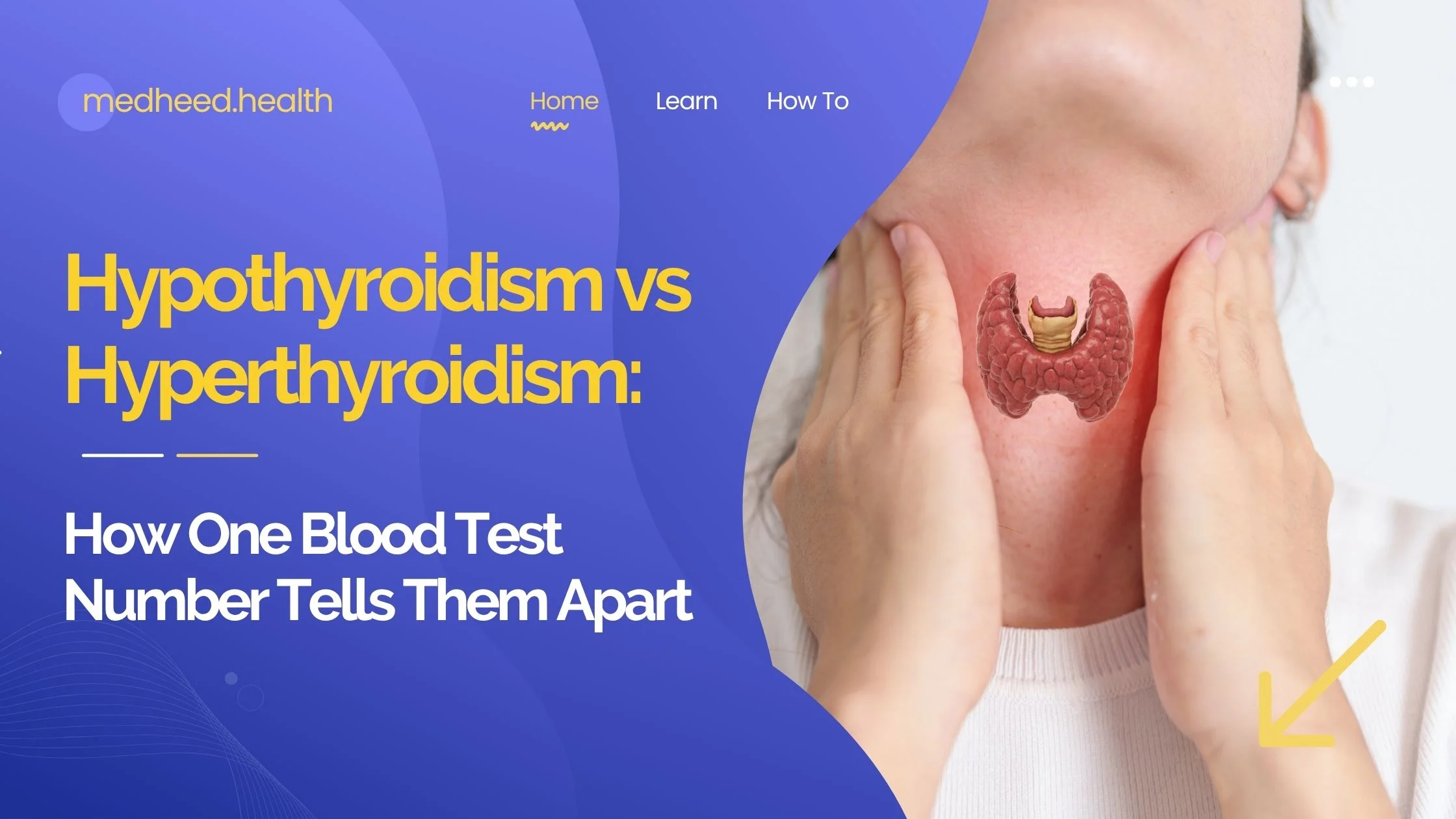
Same Gland. Opposite Problems. One Number Separates Them.
Kavya, 29, had been gaining weight steadily for six months despite eating carefully. Always cold. Always tired. Always foggy.
Her colleague Sunita, 35, had the opposite problem — losing weight without trying. Heart racing at rest. Anxious. Sweating constantly.
Both went to the doctor. Both got a TSH test. One number told their stories apart — completely.
That number was TSH. And understanding what it means for each condition could save you months of confusion and misdiagnosis.
First — What Is TSH and Why Does It Matter?
TSH (Thyroid Stimulating Hormone) is produced by your pituitary gland. Its job is to tell your thyroid how much hormone to make.
Here is the relationship that makes everything click:
- Thyroid underperforming → Pituitary works harder → TSH goes UP
- Thyroid overperforming → Pituitary backs off → TSH goes DOWN
This is why TSH moves in the opposite direction to thyroid function. It is not measuring what your thyroid is producing — it is measuring how hard your brain is pushing your thyroid to work.
Normal TSH range: 0.4 – 4.0 mIU/L
That one number — above or below normal — is what separates hypothyroidism from hyperthyroidism.
Hypothyroidism — When Your Thyroid Is Too Slow
TSH: Above 4.0 mIU/L
Hypothyroidism means your thyroid is underactive — not producing enough thyroid hormone. Your pituitary responds by releasing more and more TSH, essentially shouting at the thyroid to work harder.
The higher the TSH, the more your thyroid is struggling.
What it feels like:
- Persistent fatigue — no matter how much you sleep
- Unexplained weight gain despite no change in diet
- Feeling cold all the time — even indoors
- Dry skin, brittle nails, hair thinning or loss
- Constipation and sluggish digestion
- Brain fog, poor memory, slow thinking
- Low mood, mild depression
- Puffy face — especially around the eyes in the morning
Who gets it:
Women are 5–8 times more likely than men to develop hypothyroidism. The most common cause worldwide is Hashimoto's thyroiditis — an autoimmune condition where the immune system attacks the thyroid gland. Other causes include iodine deficiency, thyroid surgery, and certain medications.
Kavya's TSH came back at 8.4 mIU/L. Her T4 was low. Her TPO antibodies were elevated at 280 IU/mL — confirming Hashimoto's. She was started on levothyroxine. Within eight weeks, the fatigue began lifting.
Hyperthyroidism — When Your Thyroid Is Too Fast
TSH: Below 0.4 mIU/L
Hyperthyroidism means your thyroid is overactive — producing too much thyroid hormone. Your pituitary detects the excess and pulls back on TSH production. In severe cases, TSH drops so low it becomes undetectable.
The lower the TSH, the more your thyroid is racing ahead unchecked.
What it feels like:
- Unexplained weight loss despite eating normally or more
- Rapid or irregular heartbeat — even at rest
- Feeling hot and sweating excessively
- Trembling hands
- Anxiety, nervousness, restlessness
- Frequent bowel movements or diarrhea
- Difficulty sleeping despite exhaustion
- Bulging eyes — in cases of Graves' disease
Who gets it:
The most common cause is Graves' disease — another autoimmune condition where the immune system stimulates the thyroid to overproduce hormones. Other causes include thyroid nodules and thyroiditis.
Sunita's TSH came back at 0.08 mIU/L — critically low. Her Free T4 was elevated at 2.6 ng/dL. TSH receptor antibodies confirmed Graves' disease. She was referred to an endocrinologist and started on antithyroid medication.
Side by Side — The Key Differences
| Hypothyroidism | Hyperthyroidism | |
| TSH Level | High (above 4.0) | Low (below 0.4) |
| Thyroid activity | Underactive | Overactive |
| Weight | Gain | Loss |
| Energy | Exhausted | Restless |
| Temperature | Always Cold | Always Hot |
| Heart rate | Slow | Fast or irregular |
| Mood | Low, Depressed | Anxious. Nervous |
| Digestion | Constipation | Frequent bowel movements |
| Most common cause | Hashimoto's | Graves disease |
The Tests You Need Beyond TSH
TSH is the starting point — not the finish line. Once TSH flags an issue, these tests confirm the full picture:
Free T4 (FT4) — Normal: 0.8–1.8 ng/dL
Low T4 + High TSH = Hypothyroidism confirmed
High T4 + Low TSH = Hyperthyroidism confirmed
Free T3 (FT3) — Normal: 2.3–4.2 pg/mL
The active thyroid hormone. Elevated in hyperthyroidism. Low in significant hypothyroidism.
TPO Antibodies — Normal: below 35 IU/mL
Elevated in Hashimoto's thyroiditis — the autoimmune driver of most hypothyroidism cases.
TSH Receptor Antibodies (TRAb) — Elevated in Graves' disease — the autoimmune driver of most hyperthyroidism cases.
Reading all of these together gives your doctor a complete picture — not just which direction your thyroid is off, but why.
FAQs
Q: Can hypothyroidism turn into hyperthyroidism?
Not directly — they are opposite conditions. However, people with Hashimoto's can occasionally experience temporary hyperthyroid episodes early in the disease before settling into hypothyroidism. This is sometimes called Hashitoxicosis.
Q: Can I have normal TSH but still have a thyroid problem?
Yes. Some people have normal TSH but abnormal T3 or T4 — particularly those with poor T4 to T3 conversion. Symptoms with normal TSH warrant checking Free T3 specifically.
Q: Is thyroid disease permanent?
Hypothyroidism — particularly Hashimoto's — is usually lifelong and managed with daily medication. Hyperthyroidism can sometimes resolve, especially with treatment, though Graves' disease may recur.
Q: Can stress cause thyroid problems?
Chronic stress elevates cortisol, which suppresses thyroid function and can trigger autoimmune responses. While stress alone doesn't cause thyroid disease, it can accelerate onset in genetically predisposed individuals.
Q: Can diet help manage thyroid conditions?
Yes — to a degree. Iodine is essential for thyroid hormone production. Selenium supports T4 to T3 conversion. Avoiding excessive raw cruciferous vegetables matters for hypothyroid patients. But diet supports — it does not replace — medical treatment.
How Medheed Can Help
A TSH of 0.08 and a TSH of 8.4 are both problems — but completely opposite ones requiring completely different treatment.
Medheed reads your thyroid panel — TSH, Free T3, Free T4, and antibodies — in plain language, showing you exactly where your numbers sit, what they mean together, and whether your thyroid is running too slow or too fast. Because knowing your TSH is flagged is just the beginning. Understanding what it's telling you is what actually matters.
The Bottom Line
Hypothyroidism and hyperthyroidism feel completely different, cause opposite symptoms, and require opposite treatments — but both are identified by the same single number: TSH.
High TSH means your thyroid needs help. Low TSH means your thyroid is working too hard. Everything else — the symptoms, the causes, the treatment — flows from that one distinction.
If something feels off with your energy, weight, heart rate, or mood — and you haven't checked your thyroid — one simple blood test could finally give you answers.
References
- Garber, J. R., et al. (2012). Clinical practice guidelines for hypothyroidism in adults. Endocrine Practice, 18(6), 988–1028.
- Ross, D. S., et al. (2016). American Thyroid Association guidelines for diagnosis and management of hyperthyroidism. Thyroid, 26(10), 1343–1421.
- Vanderpump, M. P. J. (2011). The epidemiology of thyroid disease. British Medical Bulletin, 99(1), 39–51.
- Biondi, B., & Cooper, D. S. (2008). The clinical significance of subclinical thyroid dysfunction. Endocrine Reviews, 29(1), 76–131.
- Toft, A. D. (2001). Subclinical hypothyroidism. New England Journal of Medicine, 345(7), 512–516.
- American Thyroid Association. Thyroid Disease Information. https://www.thyroid.org
- World Health Organization. (2007). Assessment of Iodine Deficiency Disorders. https://www.who.int